You might not like Trump, but no one can deny that America's chronic disease burden is catastrophic. Someone needs to do something. It's time.
On Super Bowl Sunday, as Americans were chowing down on the traditional game day buffet of ultra-processed junk foods, they were suddenly confronted by Mike Tyson.
Mr. Tyson delivered a surprising message: “Processed food kills.”
Speaking from the heart, Tyson discussed his family’s battle with obesity and related illnesses.
“Something has to be done about processed food in this country,” the former heavyweight boxing champion of the world declared.
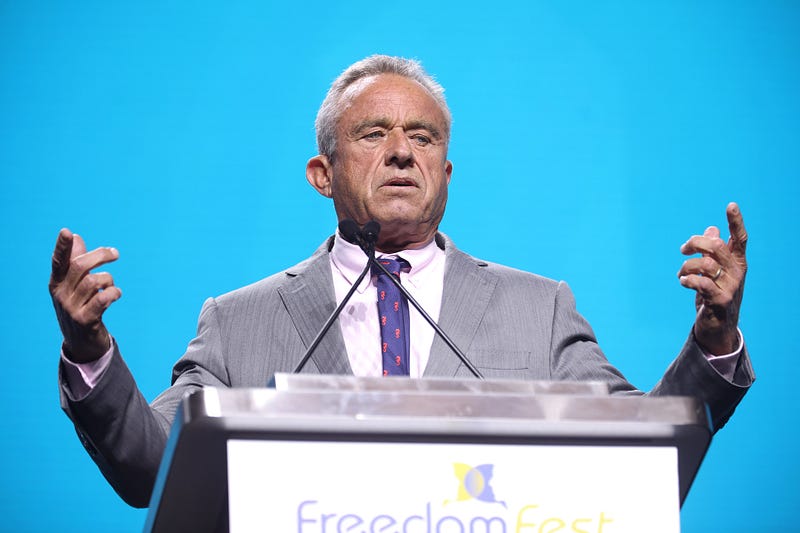
“They gave Mike Tyson a script,” said Health and Human Services Secretary Robert F. Kennedy Jr. in an interview with Peter Doocy and Fox News on Sunday. “The script wasn’t working, and he just started talking. It was an extraordinary, powerful ad. I think it’s the most important ad in Super Bowl history, because it’s a crisis, Peter, that’s existential.”
“Seventy-seven percent of our kids cannot qualify for military service,” complained RFK Jr. “Obesity is off the charts. Thirty-eight percent of American teens are diabetic or prediabetic. And the cost to our country is ruinous. When my uncle was president, we spent a fraction of what we spend today on chronic disease. Now we spend $3.4 trillion a year, and it’s growing faster than anything else in the budget, and it’s going to bankrupt us.”
“This is spiritual warfare,” he declared. “This is a spiritual malaise which affects mental health. Despite what The New York Times says, there are 75 years of peer-reviewed science showing that improving your health improves even the symptoms of schizophrenia, ADHD, and bipolar disorder. When you give people in prison real food, violence goes down by 40 percent. The use of restraints goes down by 75 percent. Food is affecting everything that we do. This is warfare.”
“If a foreign enemy or adversary did this to our country, we would consider it an act of war,” RFK Jr. went on passionately. “We are poisoning our children at scale, at a cellular level, and it needs to stop. The Trump administration does not believe in being a nanny state. It’s not going to tell you that you cannot buy doughnuts. If you want to buy doughnuts, you should be able to do that. We live in America.”
“Americans have to be the CEO of their own health,” RFK Jr. cautioned. “They have to take control of it. We are equipping them with the tools to do that. We’re telling them what the science says. We’re telling them what kinds of food they should be eating. It’s up to everybody to do that, and it’s really going to be a civics project from now on.”
“People can eat what they want to eat,” he reiterated. “They can eat Buffalo wings, but you should check the ingredients. There are a lot of seed oils, corn syrup, artificial flavors. You probably shouldn’t be eating those.”
“Marty Makary, who has done an extraordinary job at the FDA, has approved six new vegetable dyes,” he explained. “We’ve changed the rules so manufacturers can say “all natural” if they use those dyes. Virtually the entire industry has pledged to get off the nine petroleum-based synthetic dyes that are absolutely destroying public health in this country by the end of this year. There are healthy alternatives now.”
“You don’t have to punish yourself with your diet,” insisted the HHS Secretary. “You should pay attention to it.”
Paying attention to the American food system, one inescapable fact leaps out: America is sick. Profoundly so.
Heart disease is the number one killer of Americans. Obesity-related illnesses — diabetes, fatty liver disease, autoimmune disorders, certain cancers — are no longer edge cases. They are normal. The costs, both human and financial, are staggering. And the idea that this is merely a matter of “personal responsibility” collapses the moment you look at how our food system actually works.
For decades, Americans were denied basic information about what they were eating. Restaurant chains fought nutrition disclosure tooth and nail. Ingredient lists were treated as proprietary secrets. If you wanted to know what was in your food in the 1990s or early 2000s, you had to buy obscure guidebooks that couldn’t even name the restaurant — only euphemisms like “fried onion at Australian-themed steakhouse.”
That opacity wasn’t accidental. It was profitable.
And we’ve seen this sort of predatory behavior before: From Big Tobacco companies.
Big Tobacco didn’t fall because smoking was “bad.” It fell because four things converged: addiction was undeniable, internal documents showed intent, harm occurred at normal use, and public costs became overwhelming.
Ultra-processed junk food now checks those same boxes.
Ultra-processed foods are engineered — deliberately — to override satiety, maximize craving, and drive repeat consumption. That’s not speculation; it’s product design. When companies know disclosure would change behavior and spend years lobbying to prevent it, that’s not ignorance. That’s intent.
The harm is no longer debatable. Processed meats are classified by the International Agency for Research on Cancer as a known carcinogen. Obesity-related disease burdens Medicare, Medicaid, and every American paying premiums. Children are developing conditions once reserved for middle age. No one can plausibly argue this is rare, accidental, or confined to misuse.
And yet, the burden of blame remains squarely on individuals — especially women — who were navigating a food environment designed to obscure risk while maximizing consumption.
This is why movements like MAHA — Make America Healthy Again — are gaining traction. Not because people suddenly agree on everything, but because they agree on outcomes. The chronic disease burden is catastrophic. The regulatory framework has failed. The food environment is actively hostile to human health.
Figures like Robert F. Kennedy Jr. didn’t invent this realization; they gave it language. You can reject parts of the politics and still accept the diagnosis. You can dislike the messenger and still acknowledge that the system is broken.
This isn’t about banning pleasure or policing bodies. It’s about honesty. Transparency. And finally admitting that when harm is this widespread, this predictable, and this profitable, it isn’t a series of personal failures. It’s a policy failure.
You don’t have to love MAHA to make room for it. You just have to stop pretending that what’s happening to America’s health is normal — or acceptable.
And you have to admit: someone needs to do something.
If not RFK Jr., who? If not now, when?
(Contributing writer, Brooke Bell)